M&A Buy and Build Value Creation: From Add On Volume to Scalable Platform Value
Author: David Wang
Wang Advisory GmbH (June 2026)
Why the next era rewards integration discipline, not deal count

Buy and build has been one of the most powerful value creation strategies in private equity and corporate M&A. The logic is simple. Acquire a strong platform company. Add smaller businesses. Build scale. Expand geography. Strengthen capabilities. Capture synergies. Improve margins. Create a stronger exit story. But the market has changed.
Bain defines buy and build as an explicit strategy to increase value by using a well positioned platform company to make at least four repeated add on acquisitions of smaller companies. The goal is to ensure that one plus one equals three through scale and scope benefits. [1]
Historically, the model was often supported by cheap debt, multiple arbitrage, and strong exit markets. Today, that is no longer enough. Bain notes that higher interest rates have made buy and build strategies harder to execute, especially for platforms relying heavily on multiple arbitrage. Add on acquisitions represented only 11 percent of buyout deal value in 2024, compared with a peak of 40 percent in 2015. [2]
At the same time, private equity is moving into a more demanding era. McKinsey’s 2026 private equity report states that the tailwinds of cheap leverage and multiple expansion have passed and that operational value creation is becoming a primary source of returns. [3]

The message is clear.
Buy and build remains attractive. But the winning model has changed.
The next generation of buy and build will not be won by doing more deals. It will be won by building better platforms.
The buy and build value equation
A successful buy and build strategy creates value through five levers.
• Platform quality
• Add on acquisition discipline
• Integration velocity
• Synergy realization
• Exit narrative strength
If one of these levers fails, the strategy can quickly lose value.
A weak platform cannot absorb acquisitions. Poor target selection creates complexity. Slow integration delays synergies. Weak systems create operational risk. Overstated revenue synergies damage credibility. A fragmented group may look larger, but not necessarily more valuable.

The key question is therefore not:
Can we buy more companies?
The better question is:
Can the platform repeatedly acquire, integrate, and improve businesses faster than competitors?
That is the real buy and build capability.
Seven imperatives for buy and build value creation

1. Build the platform before buying aggressively
Many buy and build strategies fail because the platform is not ready.
The first add on is often manageable. The second creates complexity. The third exposes weaknesses. The fourth tests whether the company has a real operating model or only a collection of acquired businesses.
Before scaling M&A, leadership should assess whether the platform has:
• Strong management capacity
• Clear strategy and market positioning
• Scalable finance and reporting
• Robust ERP and application landscape
• Integration playbook
• Repeatable sales and pricing model
• Clear operating model
• Strong cash and working capital discipline
• Talent and leadership depth
• Post Merger Integration governance
A platform should not only be acquisition ready. It should be integration ready. The most expensive mistake is to acquire faster than the organization can absorb.
2. Develop a granular market map
Buy and build should not be opportunistic dealmaking.
A strong strategy starts with a detailed market map.
The market map should define:
• Target segments
• Regional white spaces
• Customer groups
• Product and service adjacencies
• Capability gaps
• Competitor landscape
• Fragmentation level
• Target ownership structure
• Valuation corridor
• Integration complexity
• Synergy potential
The best buy and build programs know what to buy before targets come to market.
They build proprietary pipelines, maintain target watchlists, develop owner relationships, and continuously refresh the acquisition thesis.
This creates speed and discipline.
Speed matters because attractive add-ons are often competitive. Discipline matters because not every available target strengthens the platform.
3. Diligence the value creation case, not only the target risk
Traditional due diligence focuses on whether the target is attractive.
Buy and build diligence must also answer whether the target makes the platform more valuable.
The diligence should cover:
• Strategic fit
• Customer overlap and cross sell potential
• Product and capability complementarity
• Margin and pricing improvement potential
• Procurement and supplier synergies
• Operating model fit
• ERP, CRM, and data integration effort
• Management quality
• Culture and retention risks
• One time integration costs
• Revenue dis synergies
• Working capital impact
• Exit story contribution
The most important diligence question is not only:
Is this a good company?
The better question is:
Does this add on increase the strategic quality, financial performance, and exit attractiveness of the platform?
A small acquisition can create large value if it strengthens the platform. A larger acquisition can destroy value if it adds complexity without strategic benefit.
4. Turn integration into a repeatable machine
McKinsey notes that private equity firms use add ons to scale portfolio companies, but poor integrations can negatively affect results. [4]
In buy and build, integration is not a one time event. It is a repeatable capability.
A strong integration playbook should define:
• Pre signing integration hypothesis
• Day 1 readiness requirements
• Day 30 operating priorities
• Day 100 synergy roadmap
• Functional workstream responsibilities
• ERP and application integration logic
• HR and leadership transition plan
• Customer and supplier communication
• Synergy baseline and value tracking
• Escalation and governance cadence
The first integration builds the playbook. The second improves it. The third should be faster, sharper, and more predictable. That is when buy and build becomes a capability, not a series of transactions.
5. Manage synergies through a value ledger
Synergies are often overstated in the investment case and under managed after closing.
A buy and build platform should manage synergies through a value ledger.
The value ledger should include:
• Revenue synergies
• Cost synergies
• Capital synergies
• Procurement savings
• Pricing uplift
• Cross sell initiatives
• Working capital improvement
• Integration cost
• Dis synergies
• Responsible owner
• Timeline
• P&L impact
• Cash impact
• Execution risk
McKinsey emphasizes that cost, capital, and revenue synergies can create competitive advantage in M&A. It also notes that revenue synergies are becoming more important as investors demand clearer growth theses beyond traditional cost savings. [5]
For buy and build, this matters.
The strongest platforms do not simply report acquired revenue. They show how each acquisition improves growth, margin, cash generation, and strategic position.
6. Standardize the operating model without killing entrepreneurship
Buy and build often requires a delicate balance.
The platform needs standardization to create scale. But many add ons are founder led, customer close, and entrepreneurial. Over integration can destroy what made them attractive.
The operating model should define where to standardize and where to preserve.
Standardize where scale matters:
• Finance reporting
• Controlling and KPIs
• Procurement
• Legal and compliance
• HR basics
• IT security
• ERP master data
• Management reporting
• Sales pipeline visibility
• Pricing governance
Preserve where differentiation matters:
• Customer relationships
• Local market knowledge
• Entrepreneurial speed
• Product expertise
• Technical know how
• Industry specific delivery models
• Founder credibility
The right model is not full integration by default.
The right model is intentional integration.
7. Build the exit story from day one
Buy and build value is ultimately tested at exit.
The buyer of the platform will ask:
• Is this a real integrated company or a loose federation?
• Is growth organic or mainly acquired?
• Are margins improving?
• Are synergies realized or still theoretical?
• Is management scalable?
• Are systems and reporting professionalized?
• Can the company continue acquiring?
• Is the platform strategically attractive to multiple buyer groups?
Bain emphasizes that succeeding in buy and build today is less about getting bigger for its own sake and more about using scale and scope to drive sustainable, profitable growth. [1]
That is the exit story investors reward.
The platform should not only be larger at exit. It should be better.
Typical red flags in buy and build programs
A buy and build strategy should be challenged when one or more of the following red flags appear.
• Platform company is not integration ready
• Add on pipeline is opportunistic rather than thesis driven
• Management team lacks M&A execution capacity
• Investment case depends mainly on multiple arbitrage
• Organic growth plan is weak or unclear
• Synergies are not linked to owners, timing, and P&L impact
• ERP and reporting systems cannot scale
• Customer, pricing, and product data are fragmented
• Integration costs are underestimated
• Cultural and founder retention risks are ignored
• Acquired companies remain operationally disconnected
• No clear Day 100 roadmap exists after closing
• Exit story depends on size rather than quality
Not every red flag is a deal breaker. But every red flag should become a deal question.
Should the platform be strengthened before the next add on?
Should the valuation be adjusted?
Should integration costs be increased?
Should the synergy plan be revised?
Should management capacity be upgraded?
Should the acquisition sequence change?

The buy and build playbook
Phase 1: Platform readiness
• Assess platform strategy
• Test management capacity
• Review ERP, reporting, and data quality
• Define integration model
• Build value creation baseline
• Identify operational bottlenecks
Phase 2: Market mapping and target strategy
• Define acquisition criteria
• Segment the market
• Build target longlist and shortlist
• Identify owner relationships
• Prioritize targets by strategic fit and value potential
• Define valuation corridor
Phase 3: Due diligence and deal shaping
• Assess strategic fit
• Quantify synergy potential
• Identify integration risks
• Estimate one time costs
• Review management and culture
• Validate data, systems, and operating model fit
• Translate findings into deal structure and value creation roadmap
Phase 4: Post closing integration
• Stabilize Day 1
• Communicate clearly with employees and customers
• Activate governance
• Track synergy owners
• Integrate finance and reporting
• Prioritize quick wins
• Protect revenue momentum
Phase 5: Value creation and scaling
• Accelerate cross sell
• Harmonize pricing
• Improve procurement
• Standardize reporting
• Upgrade systems
• Strengthen leadership
• Build next acquisition pipeline
Phase 6: Exit preparation
• Show integrated performance
• Prove organic growth
• Demonstrate synergy realization
• Document integration capability
• Quantify margin improvement
• Build buyer specific equity story

Case study success story: Confidential private equity IT platform add on program
In a confidential private equity platform situation, Wang Advisory supported a buy and build related Post Merger Integration program in the IT cloud and data center services sector.
The mandate focused on supporting a PE backed platform add on strategy, managing PMI activities across multiple acquired IT service providers, and developing a repeatable PMI strategy playbook.
Key contributions included:
• Supported PE platform add on strategy
• Managed Post Merger Integration across several IT cloud and data center service providers
• Developed a PMI strategy playbook blueprint for repeatable integration
• Defined Day 30, Day 90, and Day 180 integration roadmaps
• Established practical governance, workstream logic, and integration priorities
• Supported alignment across management, functional teams, and acquired entities
• Translated the acquisition thesis into executable integration actions

The case illustrates a broader buy and build lesson. Buy and build value creation is not only about acquiring the right targets. It is about building a platform that can integrate repeatedly, absorb complexity, standardize what matters, and convert each add on into measurable value. A strong PMI playbook turns acquisitions from one off transactions into a repeatable value creation capability.
Wang Advisory positioning
Wang Advisory supports clients across M&A strategy, buy and build, commercial and Tech IT Due Diligence, Post Merger Integration, carve outs, operating model design, value creation, and transformation PMO.
Our approach combines:
• Senior M&A and transformation experience
• AI supported market mapping and target screening
• Structured due diligence and red flag assessment
• Practical PMI and integration playbooks
• Synergy tracking and value creation governance
• Day 30, Day 90, and Day 180 execution roadmaps
• Lean expert delivery without a large consulting pyramid
The objective is simple. Buy the right businesses. Integrate them faster. Capture value systematically. Build a stronger platform for exit.
The leadership message
Buy and build is not a deal volume strategy.
It is a platform transformation strategy.
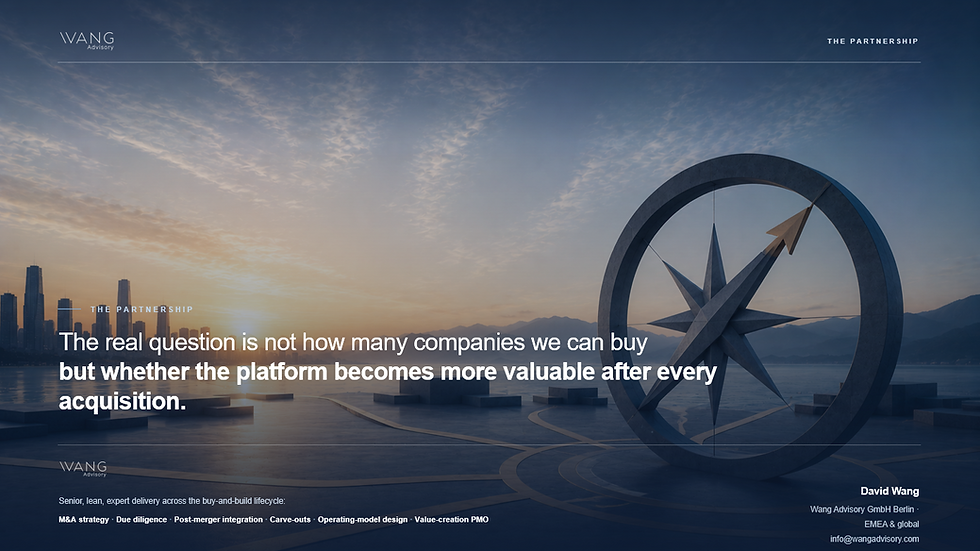
The winners will not be the investors that simply close the most add-ons. The winners will be the investors and corporates that build repeatable M&A capabilities, integrate with discipline, improve operations, and create a platform that is strategically stronger with every acquisition.
The real question is not:
How many companies can we buy?
The better question is:
Can we build a platform that becomes more valuable after every acquisition?
Sources
[1] Bain & Company, Building a Stronger Buy and Build, published 11 March 2024.
[2] Bain & Company, Private Equity Outlook 2025: Is a Recovery Starting to Take Shape?, published 3 March 2025.
[3] McKinsey & Company, Private equity: Clearer view, tougher terrain, published 10 February 2026.
[4] McKinsey & Company, Winning at private equity integrations, published 29 July 2021.
[5] McKinsey & Company, How strategic buyers can outperform financial investors by building a synergy muscle, published 13 February 2026.
[6] Boston Consulting Group, The Power of Buy and Build: How Private Equity Firms Fuel Next Level Value Creation, published 19 February 2016.
[7] EY, How the drivers of private equity value creation are changing, published 8 May 2024.
[8] Wang Advisory internal project reference, confidential private equity IT platform add on and Post Merger Integration program.


Comments