Integrated Management in the AI Era
How the St. Gallen Integrated Management Concept helps organisations move from AI experimentation to AI maturity
By David Wang | Wang Advisory GmbH
White paper in collaboration with StGallen imt Business School
Co-author: Prof. Dr. Christian Abegglen
Published on 26. August 2026

Artificial intelligence is no longer a CIO or CTO side topic. It has become a CEO-level management agenda.
The question is no longer only which tools, platforms or models the organisation should deploy. The real question is how AI changes the way the company thinks, decides, works, learns, governs and creates value. AI is moving from the technology roadmap into the corporate management system. That is why AI maturity cannot be delegated to IT alone.
It must be led as an integrated management transformation. Many organisations have already started using AI tools. Employees write faster. Teams analyse information faster. Consultants build slides faster. Developers code faster. Finance teams automate reports. Marketing teams generate content. Sales teams use AI for account preparation. But faster individual work does not automatically create a better company. This is the central AI maturity challenge.
Organisations do not become AI mature because employees use ChatGPT, Copilot, Claude or internal AI agents. They become AI mature when AI changes how the company thinks, decides, learns, organises, governs and creates value.
AI maturity is therefore primarily a management-system challenge, not merely a technology-deployment challenge.
That is why the St. Gallen Integrated Management Concept is highly relevant for the AI era.
The St. Gallen Integrated Management Concept provides a holistic management architecture for dealing with complexity. It connects normative, strategic and operational management and helps leaders understand the company as an integrated system, not as a collection of isolated functions, tools or initiatives. [1] [2] [3] [4]
Its value is not only academic. Its value is practical.
It helps leaders connect AI with purpose, strategy, operating model, culture, governance and execution. It prevents AI from becoming a collection of disconnected tools and pilots.
It gives management a way to ask the most important question:
How does AI change the whole system of the company? AI needs exactly this perspective. Not more isolated pilots. Not more disconnected tools. Not more innovation theatre. AI needs integrated management.
Executive summary

1. The adoption curve
AI use is already widespread, but enterprise value remains concentrated among a small minority of organisations. McKinsey’s 2025 global AI survey reports that 88 percent of respondents say their organisations use AI regularly in at least one business function, up from 78 percent one year earlier. The same source reports that 23 percent of respondents are scaling agentic AI somewhere in the enterprise, while another 39 percent are experimenting with AI agents. AI high performers, defined as organisations reporting significant value and at least 5 percent EBIT impact from AI, represent only about 6 percent of respondents. [5]
2. The real gap
People are adopting AI faster than organisations are transforming.
A 2026 McKinsey transformation article reports that 70 percent of respondents feel personally prepared to adopt and use AI, while only 27 percent of leaders believe their organisations are ready for the shifts required for an agentic future. These two figures are based on different survey questions and respondent bases, so they should be read directionally rather than as a directly comparable gap. [6]
3. The diagnosis
Many organisations do not suffer from a lack of AI tools.
They suffer from organised standstill in management systems.
They have AI pilots without an integrated strategy, productivity tools without a new operating model, data initiatives without a decision architecture and AI enthusiasm without governance.
4. The answer
AI maturity means coherence.
Coherence across the external environment, the business system and the management system.
Coherence across normative, strategic and operational management.
Coherence across the nine management fields.
Coherence across end-user adoption, governance, value capture and continuous learning.
The AI maturity gap
AI adoption is growing quickly. But scaling remains difficult.Initial AI adoption is no longer the main bottleneck.
The greater challenge is translating widespread use into enterprise-wide value.
In many organisations, the issue is no longer first exposure to AI. The issue is that the operating model, governance, decision systems, capabilities, culture and value-creation logic have not yet been sufficiently redesigned around AI.

This is the core management challenge:
People are adopting AI faster than organisations are transforming.
The symptoms are visible in practice:
• Pilots multiply, but nothing is decided differently
• Tools are approved, but roles stay exactly the same
• Value is claimed anecdotally and never measured
• Governance arrives after the risk, not before it
• Employees experiment faster than leadership systems adapt
• AI usage increases, but enterprise value remains unclear
The shift is therefore not from “no AI” to “AI”.
The shift is from AI activity to AI maturity.
The so what: Why St. Gallen matters now
The St. Gallen Integrated Management Concept was developed to help leaders manage complexity in a holistic way. That is exactly the problem AI now creates.
AI does not affect only one function. It affects the entire enterprise system. It changes how people work. It changes how decisions are prepared. It changes how knowledge is used. It changes how processes are designed. It changes how risks are governed. It changes how customers are served. It changes how strategy is executed. It changes how the company renews itself.
A tool-based AI approach asks:
Which AI software should we buy?
An integrated management approach asks:
What must change in our management system so AI creates sustainable enterprise value?
That is the so what of the St. Gallen concept in the AI era.
It forces leadership to connect three levels that are often separated in AI transformation.
Normative management
What should AI mean for our purpose, values, responsibility and leadership philosophy?
Strategic management
How does AI change our business model, competitive advantage, capabilities and value-creation logic?
Operational management
How do we redesign workflows, roles, governance, data, systems and performance management so AI becomes part of everyday execution?
If these levels are not connected, AI remains fragmented.
The company may have AI tools, but no direction. It may have AI pilots, but no operating model. It may have AI productivity, but no measurable value. It may have AI enthusiasm, but no governance. It may have AI ambition, but no transformation system.
The St. Gallen Integrated Management Concept provides the missing management architecture.
Three systems, one view
AI transformation changes the environment, the business and the management system.
That is why it cannot be managed as a narrow technology programme.
A system-oriented view connects three questions.
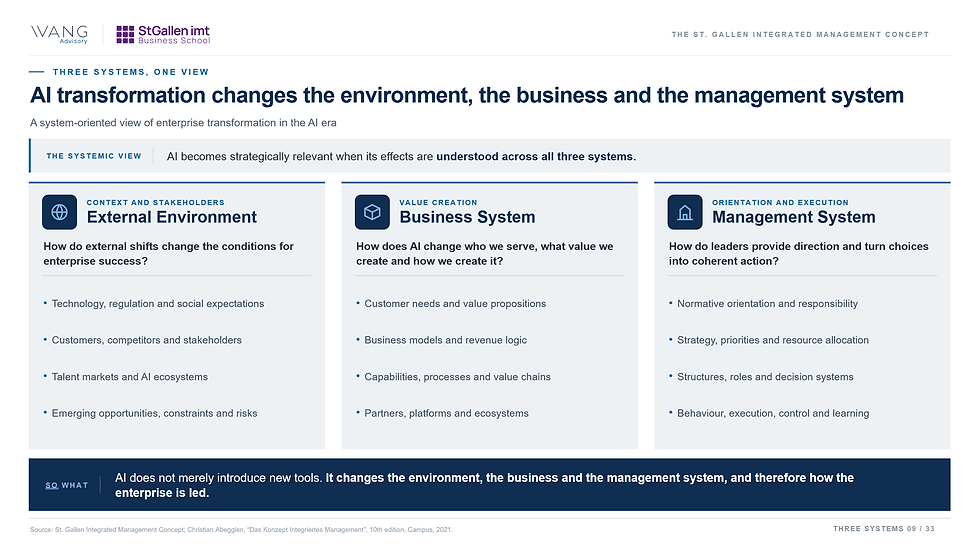
1. External environment
How do external shifts change the conditions for enterprise success?
This includes:
• Technology, regulation and social expectations
• Customers, competitors and stakeholders
• Talent markets and AI ecosystems
• Emerging opportunities, constraints and risks
2. Business system
How does AI change who we serve, what value we create and how we create it?
This includes:
• Customer needs and value propositions
• Business models and revenue logic
• Capabilities, processes and value chains
• Partners, platforms and ecosystems
3. Management system
How do leaders provide direction and turn choices into coherent action?
This includes:
• Normative orientation and responsibility
• Strategy, priorities and resource allocation
• Structures, roles and decision systems
• Behaviour, execution, control and learning
The systemic view is clear:
AI does not merely introduce new tools.
It changes the environment, the business and the management system, and therefore how the enterprise is led.
Nine fields of integration
Integrated AI management requires coherence across nine management fields.
The St. Gallen perspective connects three management levels with three dimensions of management.

Normative level: Orientation
At the normative level, AI maturity requires clarity on the organisation’s identity, principles and legitimacy.
• Constitution and governance: authority, accountability and rules for responsible AI decisions
• Corporate policy: purpose, principles and boundaries for AI-related activities
• Corporate culture: values and behavioural norms that shape trust and legitimacy
Strategic level: Positioning
At the strategic level, AI maturity requires clarity on competitive direction, capability building and transformation priorities.
• Organisational structures: roles, capabilities and coordination for human and AI work
• Strategic programmes: priorities and initiatives that turn AI ambition into advantage
• Problem-solving behaviour: how evidence, judgement and learning shape strategic choices
Operational level: Execution
At the operational level, AI maturity requires work redesign, accountability and reliable implementation.
• Processes: workflows and process structures for reliable AI-supported execution
• Assignments: operational assignments through which AI contributes to value creation
• Performance and cooperation: daily leadership, collaboration and accountable AI use
This is where integrated management becomes practical.
AI maturity is not only a question of tools, models or platforms.
It is a question of coherence across structures, activities and behaviour.
Why the St. Gallen perspective matters
The St. Gallen tradition is rooted in system thinking. It understands the company not as a machine of isolated functions, but as a living system embedded in markets, stakeholders, technology, society and culture. [1] [3]
Knut Bleicher developed this thinking into the Concept of Integrated Management, connecting three levels of management:
• Normative management
• Strategic management
• Operational management
Christian Abegglen has played a central role in continuing, updating and transferring this body of knowledge into practice. The 10th fully updated and expanded edition of “Das Konzept Integriertes Management: Visionen – Missionen – Programme” is described as Knut Bleicher’s life work continued by Christian Abegglen, supported by the St. Gallen Denk und Wissensnavigator and the St. Gallen Management HAUS. [1] [2] [3]
StGallen imt Business School uses the integrated management concept as a central orientation framework and explicitly connects management, technology and practical knowledge in its executive education approach. [3] [4]

Prof. Dr. Christian Abegglen:“AI maturity is not achieved by introducing more tools. It is achieved when leadership integrates AI into the normative, strategic and operational logic of the organisation. The decisive question is not whether a company uses AI, but whether AI strengthens the entire management system and the organisation’s ability to renew itself.” [7]
This is important because AI transformation is not only about models, prompts and automation.
It is about the integration of:
• Purpose
• Strategy
• Business model
• Organisation
• Processes
• Data
• Technology
• People
• Culture
• Governance
• Risk
• Performance management
The St. Gallen perspective helps leaders avoid one of the biggest AI mistakes:
Treating AI as a tool rollout instead of an enterprise transformation.
From integrated management to enterprise reinvention
Christian Abegglen’s book “Unternehmen neu erfinden: Das Denk- und Arbeitsbuch gegen organisierten Stillstand” is an important bridge between the St. Gallen Integrated Management Concept and practical enterprise transformation.
The second fully revised edition was published by Frankfurter Allgemeine Buch in March 2021. It is positioned as a practical Denk- und Arbeitsbuch for leaders who want to implement the St. Gallen Management Concept in their own organisation. [8]
StGallen imt Business School describes the book as a work book and standard reference for implementing the St. Gallen Management Concept in practice. With the St. Gallen Management House blueprint, readers are guided to review and shape their own company as a method for enterprise development and as a practical response to organised standstill. [8]
This perspective is highly relevant for AI transformation.
Many organisations today do not suffer from a lack of AI tools. They suffer from organised standstill in management systems.
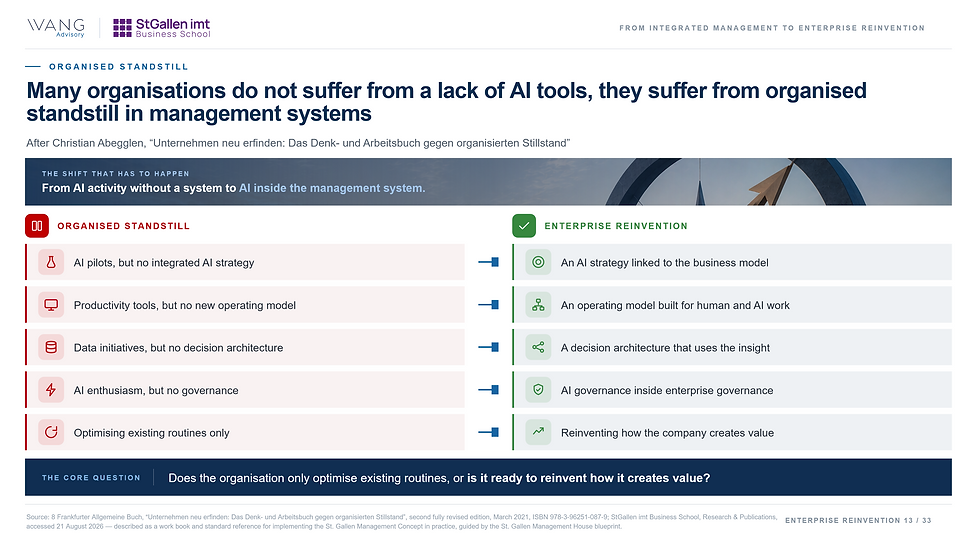
They have AI pilots, but no integrated AI strategy. They have productivity tools, but no new operating model. They have data initiatives, but no decision architecture. They have AI enthusiasm, but no governance. They optimise existing routines, but do not reinvent how the company creates value.
The core question from “Unternehmen neu erfinden” can therefore be translated into the AI era: Does the organisation only optimise existing routines, or is it ready to reinvent how it creates value?
This is where AI and the St. Gallen Integrated Management Concept meet.
AI maturity is not only about using better tools. It is about enabling the organisation to continuously reassess its position, define a future direction, redesign its management system and navigate towards renewal.
In this sense, AI-driven transformation is not only digital transformation.
It is enterprise reinvention.
It requires leaders to challenge organised standstill, rethink the company as a whole system and translate AI from isolated use cases into normative clarity, strategic renewal and operational execution.
AI maturity is an integrated management problem
Most organisations start AI transformation from the operational layer.
They ask:
Which tools should we buy? Which use cases should we test? Which processes can we automate?Which employees should get access? Which vendor should we select?
These questions are necessary.
But they are not sufficient.
An integrated management perspective asks deeper questions.
Normative level
What role should AI play in our company identity, purpose, responsibility and leadership philosophy?
Strategic level
How will AI change our business model, competitive advantage, value proposition, operating model and future capabilities?
Operational level
How do we redesign workflows, roles, systems, data flows, governance and performance management to capture value safely and repeatedly?
Governance must not be treated as a purely operational control function. It has a normative and structural role, because it defines principles, accountability, boundaries, trust and legitimacy. At the same time, it cuts across strategy and operations, because AI must be governed in the way it is prioritised, deployed, used, monitored and improved.
This is where the St. Gallen logic becomes practical.
It turns AI maturity from a technical readiness question into a management-system question.
Not: Do we have AI tools?
But: Is our organisation designed to use AI responsibly, strategically and productively?
The Integrated AI Maturity Framework
Building on the St. Gallen Integrated Management Concept, the following maturity framework translates systemic coherence into a practical transformation agenda.
It does not replace the St. Gallen concept.
It operationalises selected consequences of the integrated management perspective for AI transformation.

The Wang Advisory AI Maturity Framework is a practice-based diagnostic framework informed by client work, management research and the St. Gallen Integrated Management Concept. It is designed to support structured discussion, diagnosis and transformation planning.
It should not be understood as an empirically validated maturity assessment unless such validation is conducted separately.
The framework assesses AI maturity across five maturity stages and three management layers.
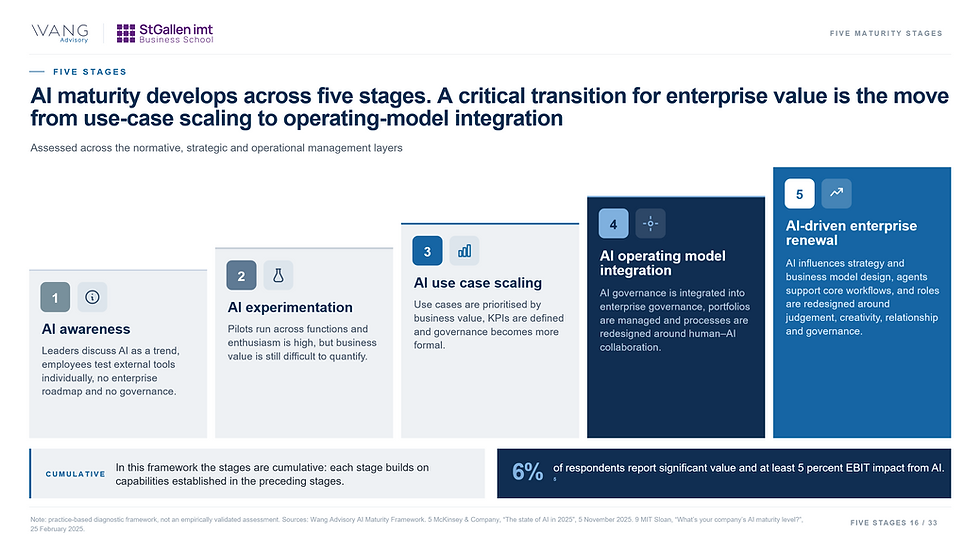
The five maturity stages are:
• Stage 1: AI awareness
• Stage 2: AI experimentation
• Stage 3: AI use case scaling
• Stage 4: AI operating model integration
• Stage 5: AI-driven enterprise renewal
The three management layers are:
• Normative AI management
• Strategic AI management
• Operational AI management
Together, they create a practical framework for assessing where the organisation stands and what must change next.
In this framework, maturity means coherence.
It means coherence across the organisation’s external environment, business system and management system.
It also means coherence across the nine Wang Advisory assessment dimensions described later in this article: leadership ambition, normative clarity, strategic value thesis, use case portfolio, data and technology foundation, operating model, people and culture, risk, trust and compliance, and performance management.
These cross-cutting assessment dimensions operationalise AI maturity.
They do not replace the nine fields of the St. Gallen Integrated Management Concept.
Five maturity stages
AI maturity develops across five cumulative stages.
Each stage builds on capabilities established in the preceding stages.
A critical transition for enterprise value is the move from use-case scaling to operating-model integration.

Stage 1: AI awareness
At this stage, the organisation understands that AI matters, but has not yet built a structured response.
Typical characteristics:
• Leaders discuss AI as a trend
• Employees test external tools individually
• No enterprise AI roadmap exists
• Use cases are informal and fragmented
• No clear AI governance is in place
• Risk, compliance and data protection are reactive
• Productivity gains are anecdotal
• AI capability building is limited
The main risk: The company confuses awareness with readiness. Leadership message: AI awareness is not AI maturity. It is only the starting point.
Stage 2: AI experimentation
At this stage, teams begin testing AI use cases across functions.
Typical characteristics:
• Pilot projects are launched
• Functions test AI for research, reporting, content, coding or customer service
• Some AI tools are officially approved
• Innovation teams or digital teams coordinate early initiatives
• Employees show enthusiasm
• Risk and compliance functions start asking questions
• Business value is still difficult to quantify
Typical challenges:
• Too many disconnected pilots
• No clear prioritisation logic
• No consistent data foundation
• Limited reuse of learnings
• Unclear accountability
• No standardised AI risk assessment
• No clear link to strategy
The main risk: The organisation builds an AI playground, not a transformation engine. Leadership message: Experimentation counts only if it creates learning and a path to scaling.
Stage 3: AI use case scaling
At this stage, selected use cases move beyond pilots and start creating measurable value.
Typical characteristics:
• Use cases are prioritised by business value
• AI initiatives are linked to cost, growth, quality, speed or risk outcomes
• Data and technology requirements become more explicit
• Training programmes are introduced
• Functions begin embedding AI into daily workflows
• Governance becomes more formal
• KPIs are defined for adoption, usage and value contribution
Typical use cases:
• Knowledge management
• Customer service automation
• Sales enablement
• Financial planning support
• Procurement analytics
• Software development acceleration
• HR process automation
• Legal document review
• Management reporting
• Strategy and market intelligence
The main risk: The company scales use cases without redesigning the underlying work. Leadership message: Workflows, decision rights, roles and incentives have to change too.
Stage 4: AI operating model integration
At this stage, AI becomes part of the operating model.
This is where AI maturity becomes a real management capability.
Typical characteristics:
• AI governance is integrated into enterprise governance
• Business, IT, data, risk, legal and HR work together
• AI portfolio management is in place
• Use cases are linked to enterprise strategy
• Processes are redesigned around human-AI collaboration
• Decision rights are clarified
• AI literacy becomes role-based
• AI risk management is formalised
• Data quality and platform architecture are treated as strategic assets
• AI performance is tracked at management level
This stage aligns with leading AI maturity research. MIT Sloan describes AI maturity as a way to assess capabilities, identify gaps and create roadmaps across processes, technology and organisational culture. [9]
The main risk: The organisation creates AI structures, but does not change leadership behaviour. Leadership message: AI maturity requires management maturity.
Stage 5: AI-driven enterprise renewal
At this stage, AI becomes part of how the enterprise renews itself.
The organisation no longer asks only how AI can improve existing processes.
It asks how AI changes the company’s future logic.
Typical characteristics:
• AI influences strategy and business model design
• Management uses AI-supported decision intelligence
• AI agents support core workflows
• Human roles are redesigned around judgement, creativity, relationship, governance and exception handling
• New AI-enabled products, services or business models emerge
• The organisation continuously learns from AI-generated insights
• Performance management includes AI value capture
• AI governance, risk and ethics are embedded into leadership routines
• Culture supports experimentation, responsibility and adaptation
The main risk: The company becomes technologically advanced but normatively unclear. Leadership message: AI-driven enterprise renewal must remain human-led, purpose-guided and value-oriented.
The strategic layer: AI needs a value thesis
A real AI strategy defines value pools, not a list of use cases.
For AI, strategic management means answering:
• Where will AI create the most value?
• Which parts of the business model will AI change?
• Which capabilities become more important?
• Which customer journeys can be redesigned?
• Which data assets create competitive advantage?
• Which processes should be automated, augmented or reinvented?
• Which AI partnerships, platforms or ecosystems are required?
• Which strategic risks emerge if competitors move faster?

Typical AI value pools include:
Growth and customer
• Revenue growth
• Customer experience
• Innovation speed
• Business model renewal
Productivity and margin
• Margin improvement
• Cost productivity
• Employee productivity
• Working capital improvement
Decision and risk
• Decision quality
• Risk reduction
• Knowledge leverage
A good AI strategy connects these value pools to the company’s market position and strategic ambition. The strategic question is not: Which AI tools should we use? The better question is: How does AI change where and how we win?
The operational layer: Why tools alone do not scale
Operational management turns strategy into daily action.
This is where many AI transformations stall.
They stall because work, roles and decision processes are not sufficiently redesigned. Companies launch AI tools, but leave processes unchanged. They ask employees to use AI, but do not redesign roles. They automate tasks, but do not change KPIs. They generate insights, but do not change decision routines. They create agents, but do not define accountability.

AI maturity requires operational redesign.
Key questions include:
• Which workflows should be redesigned around AI?
• Where should humans remain decision owners?
• Which tasks should be automated?
• Which tasks should be augmented?
• Which controls are required?
• Which data must be improved?
• Which KPIs should measure value capture?
• Which skills must be built by role?
• Which operating model changes are needed?
• Which governance forums must review AI performance and risk?
McKinsey’s AI research identifies scaling practices such as dedicated adoption teams, senior leader role-modelling, embedding AI into business processes, role-based training, feedback mechanisms, clear AI roadmaps, KPI tracking and incentives that reinforce AI adoption. [12]
NIST’s AI Risk Management Framework also reinforces the importance of governance, accountability, decision rights, oversight and escalation in the management of AI systems. [10]
This confirms a core integrated management principle:
AI does not scale through tools alone. It scales through systems, processes, leadership routines and culture.
The normative layer: AI needs purpose and responsibility
Normative management addresses the purpose, identity, principles and responsibilities of the organisation.

For AI, this means answering questions such as:
• Why do we use AI, and which value should it create?
• Which AI applications are consistent with our values?
• Which AI applications should we not use, even if technically possible?
• How do we preserve trust, fairness and accountability?
• What role should human judgement play?
• How do we define responsible AI leadership?
This layer is becoming more important as AI systems become more autonomous.
NIST’s AI Risk Management Framework describes governance as a cross-cutting function that connects AI risk management to organisational values, policies, practices and strategic priorities. [10]
McKinsey’s 2026 AI Trust Maturity Survey also highlights that responsible AI maturity is improving, but strategy, governance and agentic AI controls still lag. It finds that explicit accountability for responsible AI is associated with higher maturity, and that AI trust is increasingly viewed as a business enabler rather than only a compliance topic. [11]
The leadership implication is clear. AI maturity starts with normative clarity. Without purpose and responsibility, AI scaling can become directionless or risky.
Governance, compliance and trust
AI maturity requires governance. But governance should not be reduced to bureaucracy.
It should enable trusted and responsible scaling.
Governance, compliance and trust are what allow AI to scale responsibly, not what hold it back.
Compliance is not the opposite of trust. It is one foundation of trust.
Governance provides the management structure.

Trust creates the social and organisational confidence to use AI responsibly in daily work.
The EU AI Act entered into force on 1 August 2024 and has applied in phases since February 2025. Earlier application includes prohibited AI practices and AI literacy obligations from 2 February 2025, governance rules and obligations for general-purpose AI models from 2 August 2025, and general application from 2 August 2026, subject to exceptions and differentiated transition periods, with further obligations for certain high-risk systems thereafter. [13]
ISO/IEC 42001 provides an international standard for establishing, implementing, maintaining and continually improving an AI management system. ISO describes it as the world’s first AI management system standard. [14]
These frameworks matter because AI is moving from experimentation into enterprise operations. When AI becomes part of decisions, workflows, products, customer interactions and risk processes, companies need management systems.
The question is not whether AI governance slows innovation. The question is whether AI can scale responsibly without governance, compliance and trust.
The AI maturity diagnostic
The Wang Advisory AI Maturity Framework uses nine dimensions as an illustrative self-diagnostic. These dimensions provide a practical management lens to identify coherence, gaps and transformation priorities.

They do not replace a validated empirical assessment. No per-dimension scoring criteria are defined here. The five maturity stages should be used as provisional reference points for each dimension, and leaders should interpret the overall pattern rather than relying on the average alone. Persistent gaps in the weakest dimensions may constrain overall maturity.
1. Leadership ambition
• Is AI on the CEO and board agenda?
• Is there a clear AI ambition linked to company strategy?
• Do leaders role-model AI usage?
• Is AI treated as a transformation topic, not only an IT topic?
2. Normative clarity
• Are AI principles defined?
• Are acceptable-use boundaries clear?
• Is human accountability defined?
• Is AI aligned with the company’s purpose and values?
3. Strategic value thesis
• Are value pools quantified?
• Are AI initiatives prioritised by business relevance and value potential?
• Is AI linked to competitive advantage?
• Are AI use cases connected to business model and operating model logic?
4. Use case portfolio
• Is there a structured AI use case portfolio?
• Are use cases categorised by value, feasibility and risk?
• Are pilots killed, scaled or redesigned based on evidence?
• Are learnings reused across functions?
5. Data and technology foundation
• Are data quality, ownership and access rights clear?
• Is there a scalable AI architecture?
• Are platforms, tools and models governed?
• Are security, privacy and integration requirements defined?
6. Operating model
• Are roles and decision rights clear?
• Is there an AI transformation office or equivalent governance structure?
• Do business, IT, data, risk, legal and HR work together?
• Are workflows redesigned around human-AI collaboration?
7. People and culture
• Are employees trained by role and workflow?
• Is AI literacy embedded into leadership development?
• Are fears, incentives and adoption barriers actively managed?
• Does the culture support experimentation and responsibility?
8. Risk, trust and compliance
• Is AI risk management integrated into enterprise risk management?
• Are model risks, bias, explainability, cybersecurity and privacy assessed?
• Are EU AI Act, data protection and sector-specific requirements understood?
• Are AI systems monitored after deployment?
9. Performance management
• Are AI benefits measured?
• Are adoption, productivity, quality, risk and financial value tracked?
• Are value-capture owners defined?
• Are AI insights integrated into management reviews?
The 5C Navigator: Recursive thinking, decision and learning logic
The AI Maturity Framework describes what must become coherent.
The 5C Navigator describes how leaders should think, decide, implement and learn during the transformation.
It is the overarching thinking, decision and learning logic.
It is not a linear project plan.
AI transformation creates new evidence, new risks, new opportunities and new organisational reactions over time. Therefore, maturity cannot be built through a one-off design exercise. It requires a recursive learning process.
The 5C Navigator can be described through five recurring steps.
1. Clarify
Frame the issue, purpose, scope, boundaries and criteria for success.
For AI transformation, this means clarifying why AI matters, what problem it is supposed to solve, which value it should create and where leadership needs to set boundaries.
2. Cause
Examine evidence, assumptions, dependencies and the causes shaping the situation.
For AI transformation, this means understanding where AI activity already exists, why scaling is blocked, which dependencies matter and what the real organisational constraints are.
3. Create
Develop alternatives for strategy, organisation, technology and human-AI work.
For AI transformation, this means designing options for use cases, operating model changes, governance models, capability building and end-user adoption.
4. Commit
Evaluate options, decide, assign ownership and allocate resources.
For AI transformation, this means moving from experimentation to explicit management decisions, named owners, funding, priorities, guardrails and accountability.
5. Cultivate
Implement, measure, learn and adapt as new evidence changes the situation.
For AI transformation, this means embedding AI into workflows, tracking value contribution, updating governance and continuously improving the transformation logic.
Each new finding can trigger renewed clarification, diagnosis and design.
This distinction is important.
The 5C Navigator is the recursive logic of thinking, decision-making and learning.
The six-phase playbook is the practical implementation sequence.
Together, they ensure that AI transformation is both conceptually coherent and operationally actionable.
The playbook: From AI maturity diagnostic to transformation roadmap
An integrated AI maturity journey should follow six phases.
The six phases are not a linear waterfall.
They are revisited recursively as new evidence, risks and learning emerge.

Phase 1: Diagnose the current AI maturity
• Map existing AI tools and use cases
• Assess maturity across normative, strategic and operational layers
• Identify gaps in leadership, governance, data, technology, people and value capture
• Benchmark maturity against business ambition
Key output:
AI maturity baseline and gap analysis.
Phase 2: Define the AI value thesis
• Identify value pools
• Prioritise business functions and processes
• Estimate financial and operational value potential
• Link AI ambition to strategy and business model
Key output:
AI value thesis and prioritised transformation agenda.
Phase 3: Build the AI governance model
• Define AI principles
• Clarify decision rights
• Establish AI risk assessment logic
• Integrate legal, compliance, cybersecurity and data protection
• Define escalation and review forums
Key output:
AI governance and operating model blueprint.
Phase 4: Redesign work around AI
• Select priority workflows
• Define human-AI roles
• Redesign processes and controls
• Embed AI into tools and routines
• Train employees by role
Key output:
AI-enabled workflow redesign roadmap.
Phase 5: Scale end-user adoption and value capture
• Track adoption and value contribution
• Measure productivity, quality, cost, revenue and risk outcomes
• Build feedback loops
• Improve models, prompts, agents and processes
• Scale successful patterns across functions
• Identify adoption blockers
• Train managers as AI adoption coaches
Key output:
AI value ledger, adoption dashboard and scaling roadmap.
Phase 6: Institutionalise AI maturity
• Embed AI into strategy cycles
• Integrate AI into management reviews
• Update governance as regulation and technology evolve
• Build continuous learning capabilities
• Use AI to support enterprise renewal
Key output:
AI management system and continuous transformation model.
After Phase 6, the process does not end.
The organisation returns to diagnosis with better information, stronger capabilities and new strategic questions.
This is where the 5C Navigator becomes important. It reminds leaders that AI transformation is recursive: context changes, coherence must be rebuilt, capabilities must evolve, governance must adapt and learning must be institutionalised.
Enterprise value is realised in everyday work
Wang Advisory has advised various AI transformation and digital transformation projects across industries.

A recurring lesson is clear:
Enterprise value is realised when AI changes everyday work, decisions and collaboration. Strategy, roadmap and pilots are all necessary. None of them create value until the work actually changes.
This requires more than technology access.
It requires:
• AI literacy and role-based training
• Trust in the tools and clear usage guidelines
• Practical workflow integration
• Time to experiment and psychological safety
• Visible productivity benefits in daily work
• Strong communication from leadership
• Visible role-modelling by managers
• Human review and quality control
• Incentives that reward adoption
• Managers who do not treat AI usage as a threat

David Wang, Founder and CEO of Wang Advisory:“AI transformation does not become effective through strategy decks alone. It often stalls when end-users do not adopt AI, do not trust it or perceive it primarily as a threat. The real maturity test is whether AI becomes part of daily work, skills and behaviour.”
This is why the St. Gallen Integrated Management Concept matters.
It connects the management levels that AI transformation must align:
• Normative clarity so people understand why AI is used
• Strategic direction so AI supports the business model
• Operational redesign so AI becomes part of work routines
AI maturity is not a board slide.
AI maturity is visible in everyday behaviour.
Do employees use AI responsibly?
Do managers encourage experimentation?
Do teams redesign their own workflows?
Do people trust the governance?
Do employees see AI as augmentation rather than replacement?
This is where AI transformation becomes real.
Success story: PMI and AI transformation in a leading mid-cap PE portfolio company
In a confidential mid-cap private equity portfolio company in Germany, Wang Advisory supported a combined Post Merger Integration and AI transformation programme across multiple portfolio entities. [15]
The situation was typical for many PE-backed platforms. The company had grown through acquisitions and had to integrate different entities, processes, tools, reporting routines and management practices. At the same time, AI was already visible in the organisation, but not yet managed as an enterprise capability.
Details are anonymised and no client-identifying information is disclosed.

Situation
The portfolio company had several AI-related activities across functions and entities.
Some teams were testing AI tools individually. Some use cases were productivity-driven. Some automation ideas were already discussed at management level.
But there was no fully integrated view on AI maturity, adoption, governance, process relevance and value potential.
The key question was not only:
Which AI tools are available?
The better question was:
Where can AI create measurable operational value across the integrated platform?
Complication
The challenge was that AI transformation was happening in parallel with PMI.
That created several practical issues:
• Multiple entities had different process maturity levels
• AI use cases were fragmented across teams
• Existing tools and automation initiatives were not fully transparent
• End-user adoption varied significantly
• Employees were curious, but also uncertain about AI’s impact on their roles
• Integration priorities competed with AI transformation priorities
• Management needed a pragmatic roadmap, not another abstract AI strategy
• Governance, data access, tool usage and process ownership had to be clarified
The risk was clear.
Without structure, AI would remain a collection of isolated experiments.
Without adoption, AI would stay on PowerPoint level.
Without integration into daily work, AI would not create sustainable value.
Solution
Wang Advisory supported the programme with a pragmatic PMI and AI transformation approach. The work focused on assessing the current AI solution landscape, identifying realistic use cases, linking AI initiatives to integration priorities and translating opportunities into an executable roadmap.
Key activities included:
• Set up and supported the PMI office across multiple portfolio entities
• Assessed the AI tool and solution landscape
• Identified AI use cases across functions and operational workflows
• Evaluated maturity, feasibility, adoption readiness and value potential
• Prioritised use cases based on value creation and implementation effort
• Connected AI initiatives with PMI workstreams and operating model design
• Supported automation opportunities in reporting, analytics and process execution
• Defined practical governance for usage, ownership and rollout
• Built a roadmap for AI adoption, capability building and operational efficiency
• Translated AI ambition into concrete actions for management and end-users
The focus was not AI as a management slogan.
The focus was AI as a practical operating model lever.
Management outcomes
The programme helped create a clearer view of how AI could support integration, automation and operational efficiency across the platform.
The initial management outcomes were visible in five areas:
• Higher transparency on existing AI activities and tool usage
• Clearer prioritisation of AI use cases with practical business relevance
• Stronger connection between PMI, process integration and AI transformation
• More pragmatic roadmap for adoption, governance and value capture
• Automation support in reporting, analytics and process execution
The key lesson:
AI transformation in PE-backed portfolio companies should not be separated from operational value creation. It should be integrated into PMI, process redesign, reporting, automation, governance and end-user enablement. For PE platforms, the real opportunity is not to launch more AI pilots. The real opportunity is to use AI to make the integrated platform faster, leaner, more transparent and more scalable.
Typical red flags in AI maturity

An organisation should be concerned when one or more of the following red flags appear:
• AI is delegated only to IT or innovation teams
• No board or executive AI agenda exists
• AI use cases are not linked to strategy
• Employees use AI tools without clear guidance
• Data quality blocks scaling
• No AI risk assessment exists
• Legal, compliance and cybersecurity are involved too late
• AI tools are rolled out without workflow redesign
• Benefits are anecdotal and not measured
• AI pilots multiply without portfolio discipline
• Business owners are unclear
• No role-based AI training exists
• No governance for AI agents exists
• AI ethics are discussed, but not operationalised
• Employees see AI as a threat, not as augmentation
• Managers discourage AI usage because they fear loss of control
• AI adoption is measured by access, not behaviour and value
• AI ambition exists, but no AI operating model
Not every red flag is a failure.
But every red flag is a management question.
Who owns AI value creation? Who owns AI risk? Which workflows must change? Which decisions should remain human-led? Which KPIs prove value contribution? Which behaviours must change? Which fears must leadership address?
Wang Advisory perspective
Wang Advisory supports clients in AI-enabled management consulting, strategy, M&A, value creation, digital transformation, operating model design and transformation PMO.

Our AI-driven approach combines:
• Senior management consulting experience
• AI maturity diagnostic
• AI value thesis development
• AI use case prioritisation
• AI-enabled analytics and research
• Operating model and governance design
• Workflow redesign
• End-user adoption and AI skills enablement
• AI transformation roadmap development
• Value-capture and KPI tracking
• Transformation PMO and management reviews
• Lean expert delivery without a large consulting pyramid
Our delivery model follows three steps.
1. Diagnose
• AI maturity diagnostic
• Assessment across normative, strategic and operational layers
• AI value thesis
• Use case prioritisation by value, feasibility and risk
2. Design
• AI governance design
• Operating model design
• Human-AI roles, workflow redesign and controls
• Sequenced transformation roadmap with named owners
3. Deliver
• End-user adoption
• AI literacy, role-based training and adoption coaching
• AI-enabled analytics, research and management reporting
• Value capture, KPI tracking and management reviews
Across M&A and strategy, post merger integration, carve-out, digital transformation and transformation PMO, the objective is simple:
AI should not only make employees faster. AI should make the organisation more intelligent, more adaptive, more responsible and more capable of renewal.
The leadership message
AI transformation is not a technology rollout.
It is integrated management under new conditions.
The winners will not be the organisations with the most AI pilots.
The winners will be the organisations that integrate AI into purpose, strategy, operating model, culture, governance, value creation and end-user adoption.

The real question is not:
How many AI tools do we use?
The better question is:
How mature is our organisation in turning AI into daily behaviour and sustainable enterprise value?
AI maturity emerges when organisations align their external environment, business system and management system, create coherence across the nine management fields and continuously learn through a recursive transformation process.
That is the next frontier of management.
And it is exactly where the St. Gallen Integrated Management Concept becomes highly relevant again.
Sources
[1] StGallen imt Business School, Research & Publications: The Integrated Management Concept / Das Konzept Integriertes Management, accessed 21 August 2026.
[2] Bleicher, Knut: Das Konzept Integriertes Management: Visionen – Missionen – Programme. St. Galler Management-Konzept, Band 1. 10th revised and updated edition, continued and edited by Christian Abegglen. Campus Verlag, 13 October 2021.
[3] StGallen imt Business School, Über uns & Executive Council, including the development of the St. Gallen Integrated Management Concept and the normative, strategic and operational management levels, accessed 21 August 2026.
[4] StGallen imt Business School, StGallen Integrated Management & Strategy, management seminar description, accessed 21 August 2026.
[5] McKinsey & Company, The state of AI in 2025: Agents, innovation, and transformation, published 5 November 2025.
[6] McKinsey & Company, From adoption to impact: Three horizons of AI transformation, published 8 July 2026.
[7] Prof. Dr. Christian Abegglen, author-approved quote and conceptual feedback for this article, 2026.
[8] Abegglen, Christian: Unternehmen neu erfinden: Das Denk- und Arbeitsbuch gegen organisierten Stillstand. 2nd fully revised edition. Frankfurter Allgemeine Buch, March 2021, ISBN 978-3-96251-087-9; StGallen imt Business School, Research & Publications, accessed 21 August 2026.
[9] MIT Sloan, What’s your company’s AI maturity level?, published 25 February 2025.
[10] National Institute of Standards and Technology, Artificial Intelligence Risk Management Framework AI RMF 1.0, 2023, accessed 21 August 2026.
[11] McKinsey & Company, State of AI trust in 2026: Shifting to the agentic era, published 25 March 2026.
[12] McKinsey & Company, The state of AI: How organisations are rewiring to capture value, published 12 March 2025.
[13] European Parliament and Council, Regulation (EU) 2024/1689 laying down harmonised rules on artificial intelligence; European Commission AI Act implementation timeline, accessed 21 August 2026.
[14] International Organization for Standardization, ISO/IEC 42001:2023 Information technology, Artificial intelligence, Management system, published December 2023.
[15] Wang Advisory internal project reference, confidential leading mid-cap private equity portfolio company, Post Merger Integration and AI transformation programme, Germany.


Comments